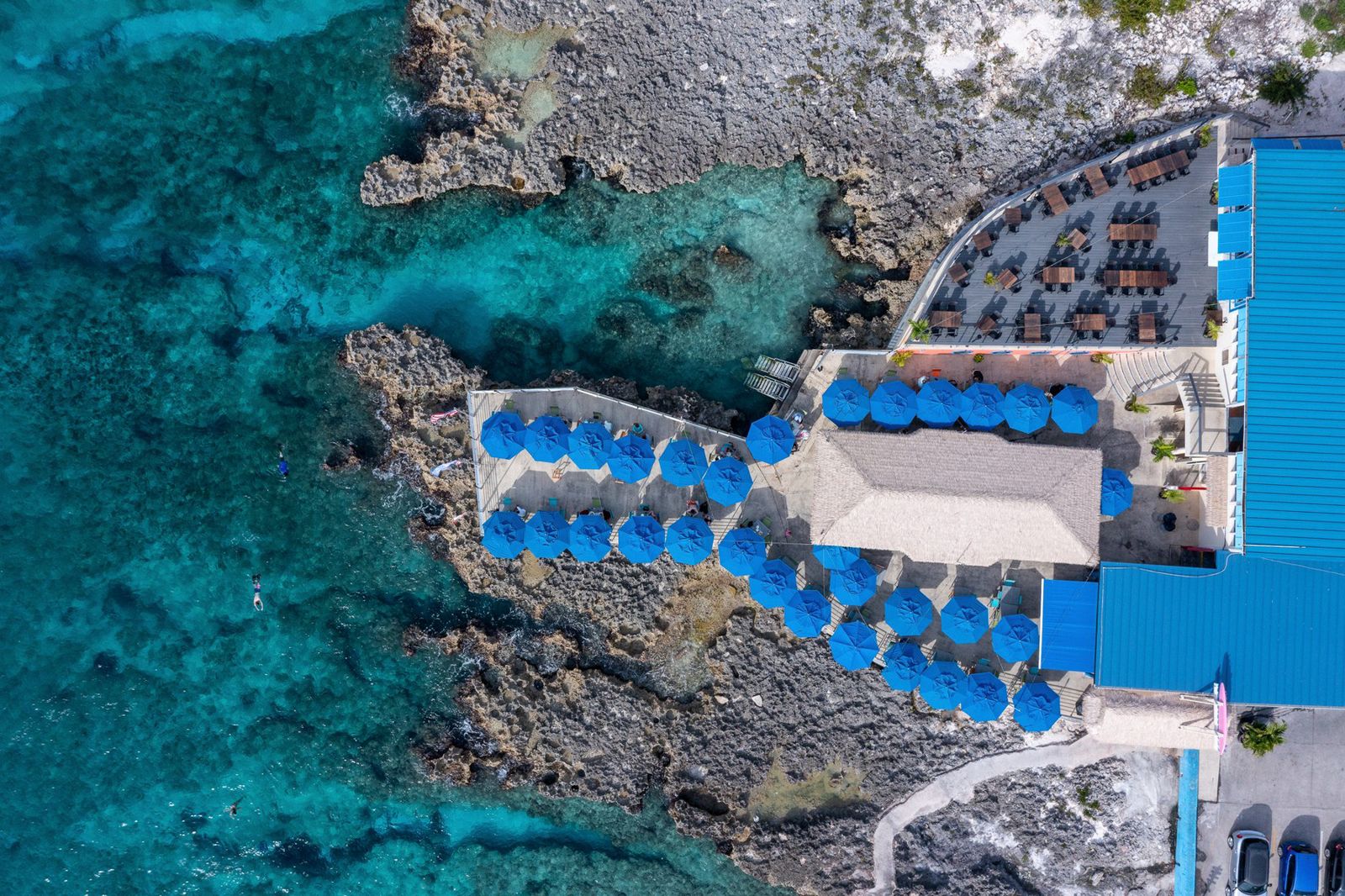
The photograph above was made from directly overhead, camera pointed straight down at an oceanfront resort beach club. Ranks of blue umbrellas run along a concrete sun deck cut into the ironshore, a thatched palapa sits at the center, a dining terrace with wood tables fills the upper right, and the resort anchors the right edge under blue metal roofs. On the left the water shifts from pale turquoise over sand to deep blue over the reef, and snorkelers float in it, small enough to read as scale rather than as subjects.
That is a great deal of information delivered without a caption. A straight down aerial, called a nadir or top down frame, shows a hospitality property, its amenity, and its setting at once. For a resort with water this good, it is often the most useful photograph in the set.
Why the Straight Down Frame Works on the Water
The familiar drone photograph is an oblique: camera tilted, horizon in the top third, building and sky doing the work. Obliques are good at architecture, and for a hotel tower or a commercial site they are usually the right choice.
Coastal properties are different, because the asset is not only the building. From an oblique, water reads as a blue band behind the resort, flattened by glare. From directly above it becomes the subject: the sand bottom, the reef structure, the exact gradient from ankle deep to drop off. Guests book on that gradient, and a top down frame is the only honest way to publish it.
The second advantage is spatial truth. An oblique flatters distance and can make a sun deck look larger than it is. Overhead, the relationships are literal. A guest can count the umbrellas and see that the swimming happens off a rock shelf rather than a sand beach, which prevents the arrival day disappointment that shows up later in review scores.
Composition Becomes Pattern, Not Perspective
Straight down, you give up every tool that depends on perspective. No leading lines, no foreground layering, no sky. What remains is shape, color, repetition, and edge, which is closer to graphic design than to conventional architectural work:
- Square the frame to a dominant line. Here it is the coastline and the run of the deck. Aligning to that line keeps the picture from feeling accidentally tilted.
- Let one repeating element set the rhythm. The umbrellas do it here. Consistent spacing reads as intentional design and gives the eye somewhere to travel.
- Divide the frame deliberately between built environment and water. One third to two thirds in either direction is a reliable start. An even split looks indecisive.
- Guard the edges. A clipped corner of parking lot is far more obvious overhead, where nothing else competes for attention.
- Keep people in, at small scale. They prove the amenity is in use and establish scale instantly, and at that size nobody needs a model release.
Timing: Sun Angle, Tide, and Water Clarity
Nadir work over water inverts the usual advice about light. Golden hour, the default answer for architecture, is close to useless here. A low sun rakes the surface, throws long umbrella shadows, and reflects straight back at the lens. To see into water you need the sun high and a polarizer on the front.
A practical sequence for scheduling the flight:
- Book the window roughly two hours either side of solar noon, when light penetrates the water column instead of bouncing off it.
- Check the tide chart before the weather. Low tide drops clarity in the shallows; a rising tide usually gives cleaner color over the shelf.
- Watch the wind forecast, not just the rain. Ten knots of onshore breeze puts enough chop on the surface to erase the bottom detail that justifies the angle.
- Look back two or three days. Heavy rain or a passing swell stirs sediment, and the water stays cloudy long after the sky clears.
- Bracket, and expose for the deck rather than the water. Bright sand and white concrete clip quickly, and a blown sun deck is harder to recover than a dark reef.
Flying the Job Without Creating a Problem
A resort beach club is an active property with guests in the frame, so the flight plan matters as much as the photograph. Work under a current Part 107 certificate and pull the airspace before you drive. Coastal Florida and most island destinations put controlled airspace, marine sanctuaries, and wildlife buffers where they are not obvious from the parking lot.
The operational side is easier to neglect. Tell the property manager when you are flying and ask the front desk to brief the beach staff. Launch away from the deck, keep the aircraft off the heads of guests, and shoot the best angles before the deck fills.
What the Property Actually Does With the Frame
A nadir aerial earns its place because it works in more channels than almost any other image in the set:
- Website hero, where the color does the persuading above the fold.
- Booking channels and map listings, where it answers the question every traveler asks about the water.
- Group sales and weddings, where it works as a site plan people enjoy looking at.
- Social, where overhead frames outperform obliques and crop cleanly to square and vertical.
- Investor and ownership reporting, where an accurate overhead of a finished amenity beats a rendering.
That range is why I shoot the overhead early rather than treating it as a bonus at the end. It sets the geography for every frame that follows.
A nadir aerial is not a trick angle. It is the only frame that shows a guest exactly what they are buying: the water, the shade, and the distance between the two.
The temptation with a drone is to keep climbing until the whole resort fits. Resist it. Altitude turns a beach club into a map, and a map does not sell a vacation. The right height is the one where umbrellas are still objects rather than dots and the reef still has texture. On this property that meant coming down well below the maximum.
If the water is the best thing your property owns, it belongs in the frame from directly above. I fly and photograph hospitality properties across Florida and the Caribbean, delivering the aerial set alongside the interiors and exteriors. Get in touch to talk through your property and we can plan the flight around your tide, your light, and your season.