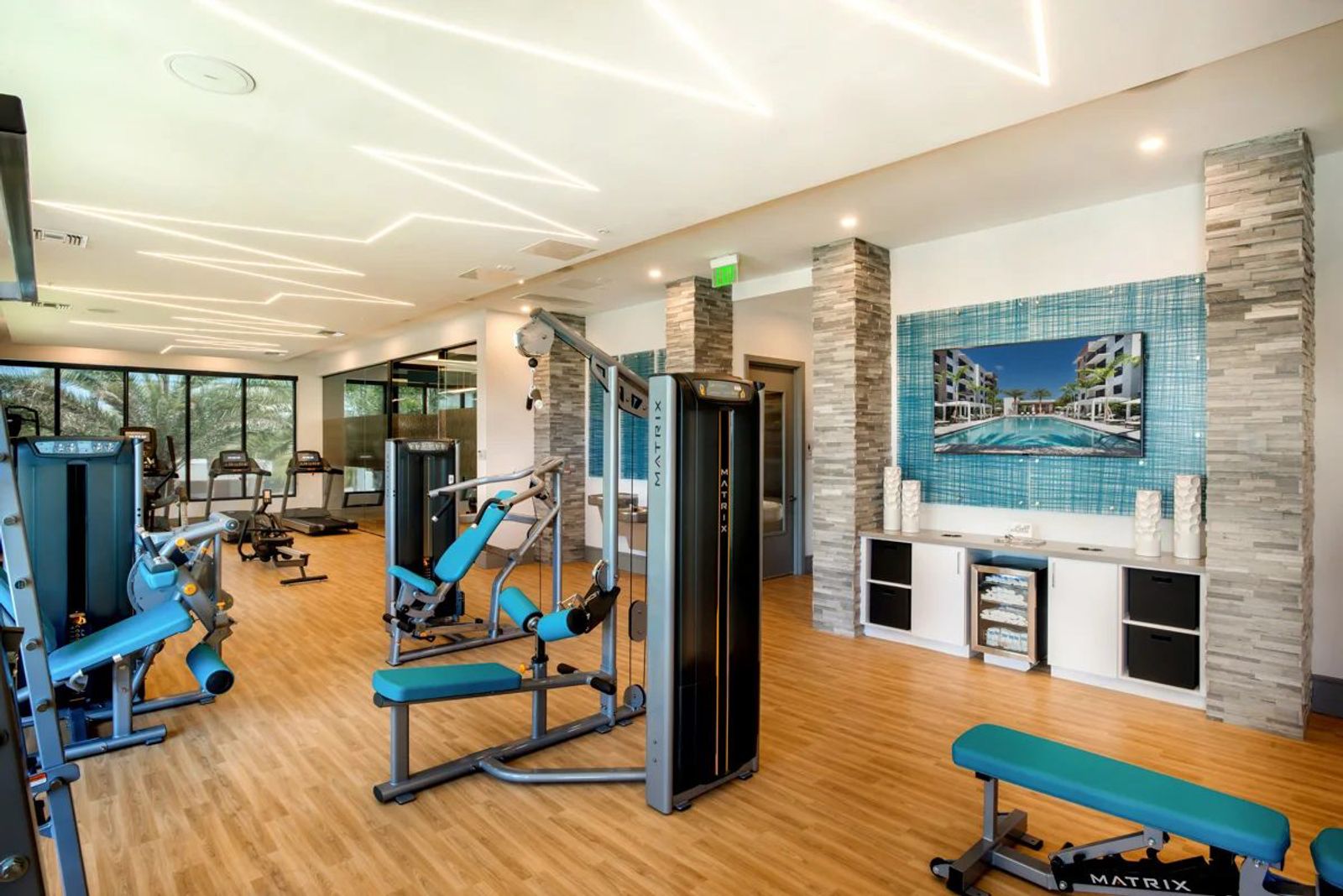
The fitness center is the amenity prospective residents ask about second, right after the pool, and it is the one most often photographed badly. The room in this frame belongs to a residential community clubhouse: strength stations and a row of cardio equipment on wood-look plank flooring, stone-clad columns breaking up the wall line, a linear ceiling detail overhead, and a glass wall on the left that opens onto landscaping and palms.
Rooms like this are difficult for reasons that have little to do with the architecture. A gym is a box full of black powder-coated steel, chrome, vinyl upholstery, and at least one large screen, all of it sitting under three color temperatures at once. Photograph it carelessly and you get a cluttered, dim room that reads like a hotel basement. The job is to render what the developer actually built, which is a bright, well-equipped amenity worth signing a lease for.
Find the Corner That Shows the Whole Program
Marketing teams are not selling one machine. They are selling the impression that the room has everything a resident needs, plus space to move around in. That impression comes from one corner position at chest height, framed to include four things:
- A strength station in the near foreground, which gives the frame depth and human scale
- A run of cardio equipment reading into the middle distance, so the room feels stocked rather than sparse
- At least one architectural element, such as the stone columns or the ceiling detail, that ties the amenity to the rest of the building
- A window or glass wall carrying daylight and a hint of what sits outside it
Keep the camera level and the verticals plumb. A fitness center is a low-ceilinged room by nature, and a tilted camera exaggerates that immediately. Chest height also keeps the machines from stacking on top of each other and lets more floor read through, which is what makes a room look open.
Stage the Equipment Before You Stage Anything Else
Machines sitting at slightly different angles make an expensive room look like a garage. Twenty minutes spent squaring equipment is the highest-return work on the entire shoot. Before the first frame:
- Square every machine to the room grid so benches, frames, and consoles share the same axis.
- Return every adjustable seat, pad, and arm to a neutral position, then match the height of matching machines.
- Rack loose dumbbells and plates in ascending order, and clear benches of stray attachments.
- Hang cable handles and straps on their pegs, or take them out of the frame entirely.
- Wipe chrome, screens, and vinyl. Fingerprints and dust are invisible to the eye and obvious at full resolution.
- Set every console to the same idle state, so one machine is not glowing brighter than its neighbors.
Property managers rarely think of this as photography work, so build it into the scope when you quote the job.
Lighting Metal, Vinyl, and Screens in a Single Frame
The room in this photograph is lit three ways: recessed LED downlights, a linear cove detail in the ceiling, and daylight through the glass wall. Left alone, that mix produces green ceilings, cool floors, and a window that blows to white. Expose for the ambient interior first, bracket separately for the window, then add bounced fill to open the shadows under and behind the equipment.
Keep flash off the lens axis. Direct on-camera light hits chrome tubing and black powder coat and returns hard specular hotspots that no amount of editing fixes. Bouncing off a ceiling or side wall wraps the equipment instead, which is what makes the machines read as three-dimensional objects rather than black silhouettes. One bounced strobe is usually enough for the whole room.
Reflections Are the Real Adversary
Nearly every fitness center has a mirror wall, a glass partition, a wall-mounted display, or all three. Each one is a surface waiting to show the photographer, the light stands, and the exit signs. Work the problem before you solve it in post:
- Choose a camera position outside the mirror's reflected cone rather than fighting it later
- Flag or switch off any light source that lands in the glass, then reintroduce it in a separate frame
- Photograph a mounted screen on its own exposure if it needs to display property imagery cleanly
- Keep the reflections that add depth, such as landscaping in a glass partition, and remove only the ones that distract
The Details That Signal a Maintained Amenity
A renter touring six communities in one afternoon remembers whether a gym looked cared for. The wide frame sells the room; two or three tighter frames sell the upkeep. Shoot the towel station stocked and squared, the beverage cooler faced and full, the wall art level, the flooring free of scuff marks. Take the waste bin out of the foreground and tuck power cords behind the equipment.
The same discipline applies to the finishes the architect specified. Stone-clad columns, a wood-look floor, and a recessed ceiling detail are what separate a community amenity from a strip-mall gym, and they only read if the exposure holds texture in them.
What the Property Actually Needs From the Set
A leasing team, a hospitality brand, and a developer's marketing group all need different crops of the same room. Deliver a set that covers every placement:
- One hero wide for the website amenity page and the listing header
- A second wide from the opposing corner, which gives a prospect a sense of the full floor plan
- Two or three mid-range frames on equipment groupings, cardio and strength kept separate
- A vertical composition for social and paid placements, framed at capture rather than cropped later
- One detail frame of the amenity station, which is the shot that reads as service
A fitness center photograph is not a product shot of gym equipment. It is a promise about how the building will feel at six in the morning, before anyone else is awake.
The equipment list is already on the website, so the photograph is not there to inventory it. It is there to convince someone that this is the room where they will keep the habit, and rooms only do that when they look bright, ordered, and maintained.
If you manage a residential community, a hotel, or a private club in Southwest Florida and your amenity photography is not doing the work it should, get in touch to discuss the project. I photograph fitness centers, clubhouses, pool decks, and the full amenity package for developers, property managers, and hospitality brands, with files sized for listings, websites, print, and paid social.