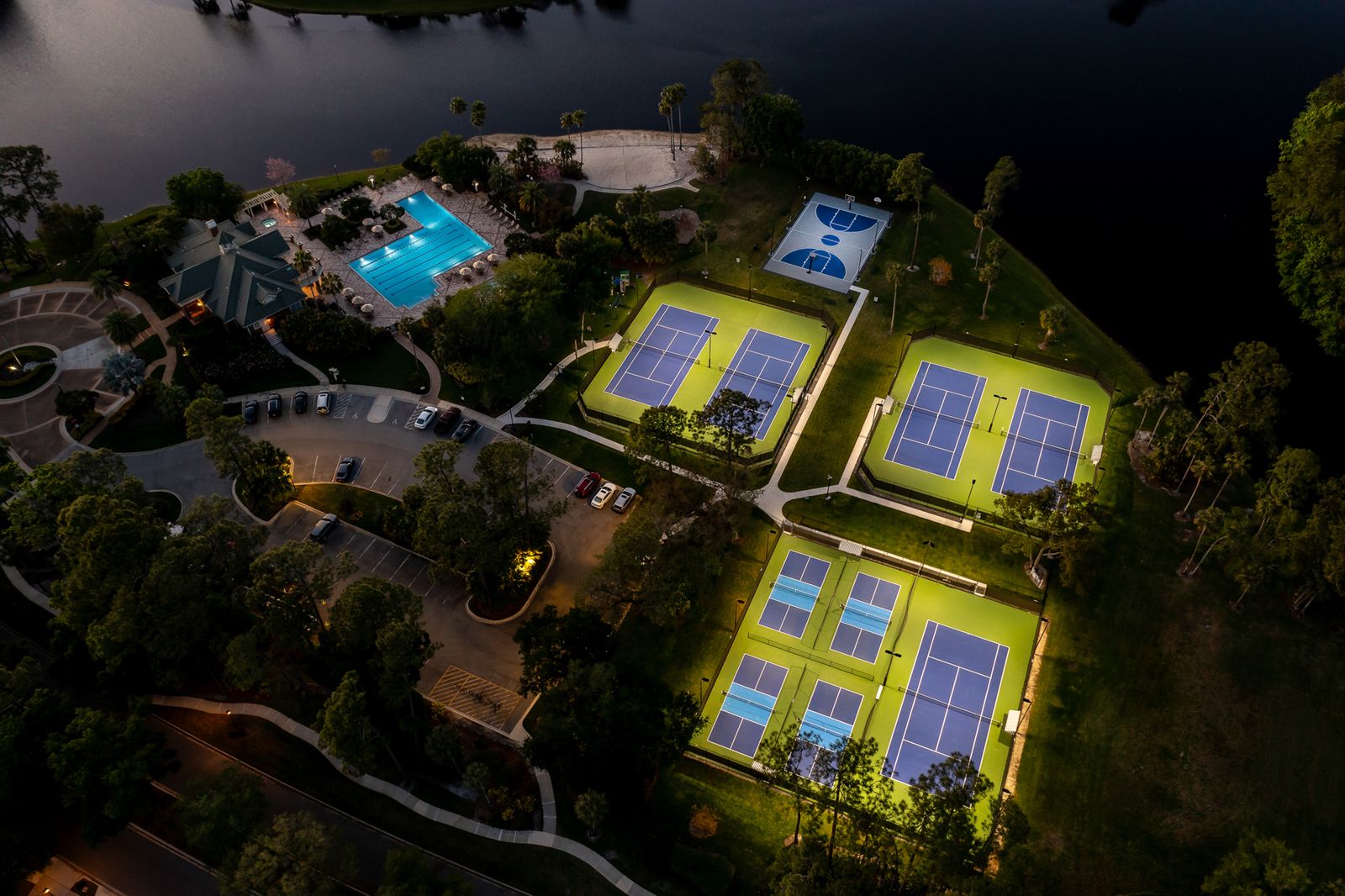
From a few hundred feet up at dusk, a community amenity center reads like a site plan come to life. In this frame the lap pool glows turquoise beside the clubhouse, six lit tennis and pickleball courts stack across the lawn in bright green rectangles, a basketball court sits at the edge of the lake, and a strip of sand beach curves along the shoreline. The water has gone dark, the canopy has dropped into shadow, and every amenity the developer built is lit and organized for the viewer in one image.
That is the job of an amenity aerial. A buyer touring a master planned community rarely walks the entire recreation campus, and a brochure full of ground level court photos cannot show how the pieces connect. A single overhead frame at the right moment of evening answers the questions a prospect actually has: how much is here, how close is it to the water, and what does it feel like when the lights come on.
Why Sports Amenities Belong in the Air
Tennis and pickleball courts are flat, repetitive, and wide. From eye level they become a wall of fencing and windscreen. From above, the line markings turn into graphic shapes and the layout itself becomes the story. Pickleball has driven a wave of court construction and conversion in Florida communities, and developers want that investment visible in their marketing.
- Court count and variety read instantly, including the mix of tennis, pickleball, and basketball surfaces.
- Walkways and lighting show how residents move between the pool, clubhouse, and courts.
- Proximity to the lake, beach, and parking is obvious without a caption.
- The scale of the campus communicates value in a way a single court photo never can.
Timing the Dusk Window
This kind of image depends on a narrow balance between ambient light and the court lighting. Fly too early and the sports lights are invisible against a bright sky. Fly too late and the trees and water go fully black while the courts blow out into white. The useful window usually lasts fifteen to twenty minutes after sunset, and the planning starts long before takeoff.
- Coordinate with the HOA or property manager so the court lights, pool lights, and clubhouse lights are all on together.
- Confirm the pool has been cleaned and the furniture and umbrellas are arranged, since every chair is visible from above.
- Launch early, frame the composition in remaining daylight, and hold position as the sky darkens.
- Bracket exposures continuously through the window so the final blend has clean highlights on the courts and detail in the canopy.
Composing a Top Down Amenity Frame
A straight down or near vertical angle works best when the amenities are spread across a site rather than stacked into a skyline. The goal is to arrange the geometry so the eye moves through the frame in a logical order. In this photograph the clubhouse and pool anchor the upper left, the courts step diagonally toward the lower right, and the dark lake wraps the top edge as a natural border.
A slight off vertical tilt can add depth by showing a hint of the clubhouse roofline and the shoreline beyond. We usually capture both versions, a pure overhead for site plan clarity and a tilted view for mood, so the marketing team has options for different placements on a website, a sales center display, or a printed brochure.
Handling Mixed Light Sources
Court lighting, pool lighting, landscape uplights, and parking lot fixtures rarely share the same color temperature. Left uncorrected, the courts can turn sickly yellow green while the pool shifts toward cyan. Careful color work in post brings each surface back to its true color without making the scene look artificial.
- Balance the court surfaces first, since their blue and green paint is often specified by the developer and must match brand materials.
- Keep the pool natural rather than oversaturated so it reads as inviting, not electric.
- Preserve the darkness of the water and tree canopy; that contrast is what makes the lit amenities pop.
- Clean up stray glare from parking lot poles and car headlights that pull attention away from the amenities.
Regulations, Safety, and Access
Twilight drone work carries real obligations. Commercial operators flying under Part 107 need proper anti collision lighting for civil twilight operations, and many communities sit near controlled airspace that requires authorization through LAANC before the flight. We also coordinate with on site management so residents are not surprised by a drone overhead, and we schedule around peak court reservations so active players are not the subject of the photograph without their knowledge.
Putting the Images to Work
A strong dusk amenity aerial earns its place across an entire marketing program. Builders use it as the hero image on community landing pages, sales teams print it large for model home walls, and property managers use it to support rental and resale listings for years after the last lot closes. It also pairs naturally with ground level coverage of the clubhouse interior, the pool deck, and the courts themselves, giving a complete picture from overview to detail.
Buyers decide whether a community fits their lifestyle long before they visit. The amenity aerial is often the image that makes them book the tour.
Developers, HOAs, and community marketing teams across Florida trust Unrue Photo to show their amenities at their best, from the air and on the ground. If you are planning a launch, a new phase, or a refresh of your community marketing, get in touch with us to schedule a twilight aerial session for your property.