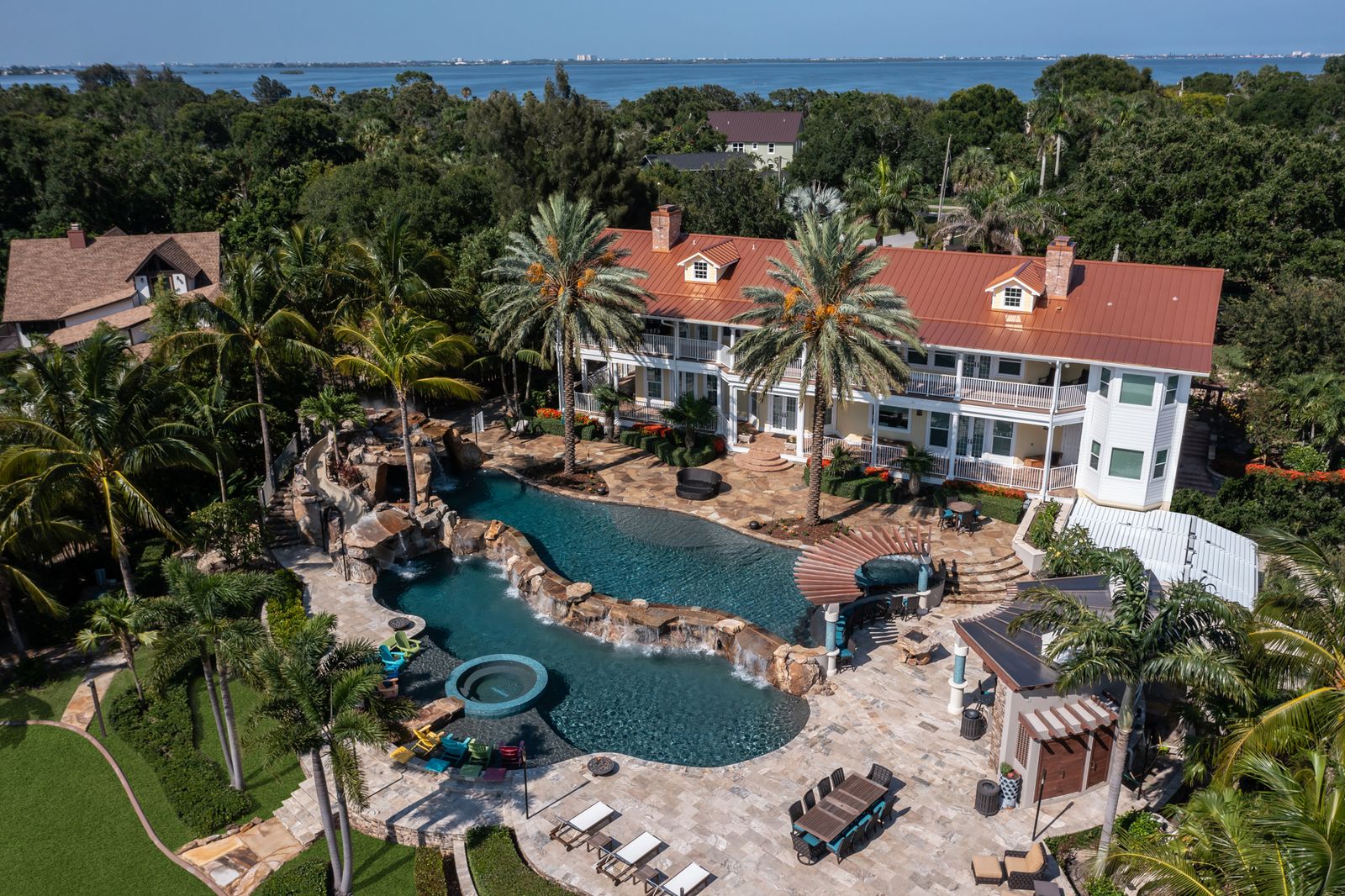
This frame looks down on a two story waterfront home from just above the treetops. Below it sits a freeform rock grotto pool with waterfalls, a slide tucked into the stone, a round spa, a wide travertine deck, a pergola bar, and a loose ring of palms. Beyond the roofline, the bay opens up and runs flat to the horizon.
From the deck, you would need four or five photographs to describe that backyard, and a viewer would still have to assemble the property in their head. From the air, it reads in one look: the pool, the deck, the shade structures, the house, and the water behind it all. For a luxury listing, that single frame often does more than the entire interior set.
What the Aerial Frame Shows That Ground Level Cannot
A resort style backyard is not one feature. It is a sequence of them, arranged around a pool and connected by decking and planting. A ground level photograph can show the waterfall or the spa or the bar, but it cannot show the relationship between them, and the relationship is what buyers are actually paying for.
The aerial frame also answers questions a listing description tends to dodge. How much usable deck is there? Does the pool sit in sun or shade? How private is the lot? How far is the water? Buyers ask those questions anyway, so it is better to answer them with a photograph than to leave them guessing.
Choosing Altitude and Angle
Most backyard aerials fail in the same two ways: too high, which turns the property into a map, or straight down, which flattens every vertical feature into a shape. A grotto pool photographed from directly overhead loses its waterfalls entirely, because the thing that makes them worth photographing is their height.
- Start low, often between 60 and 120 feet, so the house keeps its scale and the rock work keeps its depth.
- Shoot at an oblique angle, roughly 30 to 45 degrees down, which shows the deck layout while holding the facade and the pergola upright.
- Place the house along the upper third of the frame so the pool and deck carry the foreground.
- Keep the horizon level and include a band of sky or water when the view is part of the story.
- Work a slow arc around the property rather than a single hover, since the best angle is rarely the first one.
Flights are planned and flown under current FAA Part 107 rules, with airspace checked ahead of the session. On coastal and waterfront properties that step matters, because controlled airspace and seasonal restrictions are common and they affect what time of day the drone can be up at all.
Timing the Light and the Water
Pool water is the most temperamental surface on the property. Overhead midday sun turns it into a sheet of glare, while flat overcast light turns it gray and lifeless. The window that works is wider than most people expect, but it has to be chosen on purpose.
- Favor mid morning or late afternoon, when the sun is high enough to light the pool floor but low enough to keep hot reflections out of the lens.
- Fly with the sun behind or beside the camera so the water reads blue instead of silver.
- Use a circular polarizer and rotate it in the air, watching the water rather than the sky.
- Bracket exposures on high contrast scenes so the white deck holds detail and the shaded grotto does not go black.
- Run a second short flight at twilight when the pool and landscape lighting are part of the design.
Wind deserves the same attention as light. A breeze that is barely noticeable on the deck will texture the entire pool surface, and a textured pool loses the reflections and the clear water that make these frames work. Calm early air is usually worth the earlier call time.
Preparing the Property Before the Drone Goes Up
Everything visible from the air is visible in the photograph, including the parts of a property nobody thinks about at eye level. We walk the yard with the owner or agent before the first flight and reset what the camera will see from above.
- Run the pool cleaner well before the shoot and remove it, along with hoses, skimmers, and floats.
- Square the lounge chairs and umbrellas, and open the umbrellas only if they are not hiding the deck.
- Clear pool toys, towels, trash bins, and anything stored behind the pool equipment wall.
- Move vehicles out of the driveway and off the street frontage when they will appear in the frame.
- Turn on the waterfall and spa jets a few minutes early so the water is moving and clear by the first pass.
Roof condition is the one detail owners are rarely prepared for. From above, stains, debris, and dirty gutters are impossible to miss, and no amount of retouching replaces a quick cleaning before the session.
Building the Set Around the Hero Frame
One strong oblique like this one is the image that leads the listing, but it should not travel alone. A complete aerial set usually includes a wider frame that places the property in its neighborhood, a tighter pass over the pool and deck, a view along the water that shows frontage and dock access, and a twilight frame with the landscape lighting on.
Those angles also serve different channels. The wide context frame explains location on a listing portal, the tight pool frame performs on social, and the twilight frame carries print and email. Shooting them in one session costs very little extra time and gives the marketing team a set it can use for months.
A buyer scrolling a listing decides in about two seconds whether the backyard is worth the asking price. The aerial frame is usually the one making that argument.
If you are listing, building, or marketing a property where the backyard is the main event, aerial coverage belongs in the shot list from the start. Contact Unrue Photo to talk through the property, the timing, and the set of images your listing or project needs.